

- University
- Academic
- Schools/Vocational Schools
- Vocational School of Justice
- Vocational School
- Vocational School
- Department of Banking and Insurance (Turkish)
- Department of Computer Programming (Turkish)
- Department of Foreign Trade (Turkish)
- Department of Graphic Design (Turkish)
- Department of Interior Design (Turkish)
- Department of Construction Technology (Turkish)
- Department of Occupational Health and Safety (Turkish)
- Department of Media and Communication (Turkish)
- Department of Architectural Restoration (Turkish)
- Department of Radio and Tv Programming (Turkish)
- Department of Civil Aviation Cabin Services (Turkish)
- Department of Civil Aviation Transportation Management (Turkish)
- Department of Tourism and Hotel Management (Turkish)
- Department of Applied English Translation
- Vocational School Of Health Services
- Vocational School Of Health Services
- Department of Child Development (Turkish)
- Department of Physiotherapy (Turkish)
- Department of Paramedic (Turkish)
- Department of Opticianry (Turkish)
- Department of Medical Documentation and Secreteriat (Turkish)
- Department of Medical Imaging Techniques (Turkish)
- Department of Medical Laboratory Techniques (Turkish)
- Department of Elderly Care (Turkish)
- School of Applied Management Sciences
- School of Foreign Languages
- Faculties
- Faculty of Arts and Sciences
- Faculty of Fine Arts and Design
- Faculty of Law
- Faculty of Communication
- Faculty of Business
- Faculty of Engineering
- Faculty of Engineering
- Department of Computer Engineering
- Department of Biomedical Engineering
- Department of Electrical and Electronics Engineering
- Department of Industrial Engineering
- Department of Food Engineering
- Department of Genetics and Bioengineering
- Department of Aerospace Engineering
- Department of Civil Engineering
- Department of Mechanical Engineering
- Department of Mechatronics Engineering
- Department of Software Engineering
- Faculty of Health Sciences
- Medicine
- Graduate School
- Common Courses
- Schools/Vocational Schools
- Research
- Research Centers
- Library
- Smart Campus
- Technology Transfer Office
- İzmir Sciencepark
- Continuous Education Center (EKOSEM)
- Children's University
- Ethics Committee
- Teaching and Learning Center (EKOEĞİTİM)
- Psychology Application and Research Center
- Researcher Training Coordinatorship
- Research Collaborations And Innovation Coordinatorship
- Campus
- INTERNATIONAL
- Contact
- 25TH YEAR
Department of New Media and Communication
YMİ 460 | Course Introduction and Application Information
| Course Name |
Language and Pronunciation in Communication*
|
|
Code
|
Semester
|
Theory
(hour/week) |
Application/Lab
(hour/week) |
Local Credits
|
ECTS
|
|
YMİ 460
|
Fall/Spring
|
1
|
2
|
2
|
4
|
| Prerequisites |
None
|
|||||
| Course Language |
Turkish
|
|||||
| Course Type |
Elective
|
|||||
| Course Level |
First Cycle
|
|||||
| Mode of Delivery | face to face | |||||
| Teaching Methods and Techniques of the Course | Critical feedbackLecture / Presentation | |||||
| National Occupation Classification | - | |||||
| Course Coordinator | - | |||||
| Course Lecturer(s) | ||||||
| Assistant(s) | - | |||||
| Course Objectives | This course is designed to highlight the importance and use of better speaking. |
| Learning Outcomes |
The students who succeeded in this course;
|
| Course Description | Students will learn how to control their diction and pronunciation and then practice in several forms of speech. *This course could be taken without its credits being included in the total ECTS credits by the students who are enrolled in undergraduate programs in English. This course could be taken with its credits being included in the total ECTS credits by the students who are enrolled in undergraduate programs in Turkish. |
| Related Sustainable Development Goals |
|
|
|
Core Courses | |
| Major Area Courses | ||
| Supportive Courses |
X
|
|
| Media and Management Skills Courses | ||
| Transferable Skill Courses |
WEEKLY SUBJECTS AND RELATED PREPARATION STUDIES
| Week | Subjects | Related Preparation |
| 1 | The importance of language and diction in communication, the content and aim of the course, the sources that will be used in the course. | |
| 2 | Students present speaking examples with texts that they choose and ascertaining the speaking defects. | |
| 3 | The “respiration”, which is one of the 3 basic elements of speaking; respiration exercises. | |
| 4 | The “articulation”, which is the second element of speaking; making tongue twister exercises. | |
| 5 | The “voice”, which is the third element of speaking; voice practice. | |
| 6 | Vowels and consonants. | |
| 7 | The liaison in Turkish language; making liaison practice. The narrowing feature of Turkish language; studying texts. | |
| 8 | Midterm week | |
| 9 | The stress in Turkish language; studying texts. | |
| 10 | The verbal punctuation. | |
| 11 | Practice of news and programme copies. | |
| 12 | Impromptu speaking practice. | |
| 13 | On camera practice, news and programme announcing. | |
| 14 | On camera practice, news and programme announcing. | |
| 15 | Semester Review | |
| 16 | Final Exam |
| Course Notes/Textbooks | |
| Suggested Readings/Materials | Prof.Aksan D. (2003) Türkçenin Gücü – Bilgi Yayınevi ISBN: 9789754941999 Urgancı H. (2014) Ben Kim, Konuşmak Kim – Elma Yayınevi ISBN: 9789756093443 Hepçilingirler F. (2011) Türkçe Off- Everest Yayınları ISBN: 9789752894495 Taşer, S. (2015). Konuşma Eğitimi. Pegasus Yayınları. ISBN:6054263202 Şenbay, N. (2019) Söz ve Diksiyon Sanatı. ISBN:9753630146 |
EVALUATION SYSTEM
| Semester Activities | Number | Weigthing |
| Participation | ||
| Laboratory / Application | ||
| Field Work | ||
| Quizzes / Studio Critiques |
1
|
20
|
| Portfolio | ||
| Homework / Assignments | ||
| Presentation / Jury | ||
| Project | ||
| Seminar / Workshop | ||
| Oral Exams | ||
| Midterm |
2
|
40
|
| Final Exam |
1
|
40
|
| Total |
| Weighting of Semester Activities on the Final Grade |
3
|
60
|
| Weighting of End-of-Semester Activities on the Final Grade |
1
|
40
|
| Total |
ECTS / WORKLOAD TABLE
| Semester Activities | Number | Duration (Hours) | Workload |
|---|---|---|---|
| Theoretical Course Hours (Including exam week: 16 x total hours) |
16
|
1
|
16
|
| Laboratory / Application Hours (Including exam week: '.16.' x total hours) |
16
|
2
|
32
|
| Study Hours Out of Class |
14
|
2
|
28
|
| Field Work |
0
|
||
| Quizzes / Studio Critiques |
1
|
4
|
4
|
| Portfolio |
0
|
||
| Homework / Assignments |
0
|
||
| Presentation / Jury |
0
|
||
| Project |
0
|
||
| Seminar / Workshop |
0
|
||
| Oral Exam |
0
|
||
| Midterms |
2
|
10
|
20
|
| Final Exam |
1
|
20
|
20
|
| Total |
120
|
COURSE LEARNING OUTCOMES AND PROGRAM QUALIFICATIONS RELATIONSHIP
|
#
|
Program Competencies/Outcomes |
* Contribution Level
|
|||||
|
1
|
2
|
3
|
4
|
5
|
|||
| 1 |
To be able to critically discuss and interpret the theories, concepts and ideas that form the basis of the discipline of new media and communication. |
-
|
-
|
-
|
-
|
-
|
|
| 2 |
To be able to critically interpret theoretical debates concerning the relations between the forms, agents, and factors that play a role in the field of new media and communication. |
-
|
-
|
-
|
-
|
-
|
|
| 3 |
To have the fundamental knowledge and ability to use the technical equipment and software programs required by the new media production processes. |
-
|
X
|
-
|
-
|
-
|
|
| 4 |
To be able to gather, scrutinize and scientifically investigate data in the processes of production and distribution. |
-
|
-
|
-
|
-
|
-
|
|
| 5 |
To be able to use the acquired theoretical knowledge in practice. |
-
|
-
|
X
|
-
|
-
|
|
| 6 |
To be able to take responsibility both individually and as a member of a group to develop solutions to problems encountered in the field of new media and communication. |
-
|
-
|
-
|
-
|
-
|
|
| 7 |
To be informed about national, regional, and global issues and problems; to be able to generate problem-solving methods depending on the quality of evidence and research, and to acquire the ability to report the conclusions of those methods to the public. |
-
|
-
|
-
|
-
|
-
|
|
| 8 |
To be able to critically discuss and draw on theories, concepts and ideas that form the basis of other disciplines complementing the field of new media and communication studies. |
-
|
-
|
-
|
-
|
-
|
|
| 9 |
To be able to develop and use knowledge and skills towards personal and social goals in a lifelong process. |
-
|
-
|
-
|
-
|
X
|
|
| 10 |
To be able to apply social, scientific and professional ethical values in the field of new media and communication. |
-
|
-
|
-
|
-
|
-
|
|
| 11 |
To be able to collect datain the areas of new media and communication and communicate with colleagues in a foreign language ("European Language Portfolio Global Scale", Level B1). |
-
|
-
|
-
|
-
|
-
|
|
| 12 |
To be able to speak a second foreign language at a medium level of fluency efficiently. |
-
|
-
|
-
|
-
|
-
|
|
| 13 |
To be able to relate the knowledge accumulated throughout the human history to their field of expertise. |
-
|
-
|
-
|
-
|
-
|
|
*1 Lowest, 2 Low, 3 Average, 4 High, 5 Highest




NEWSALL NEWS


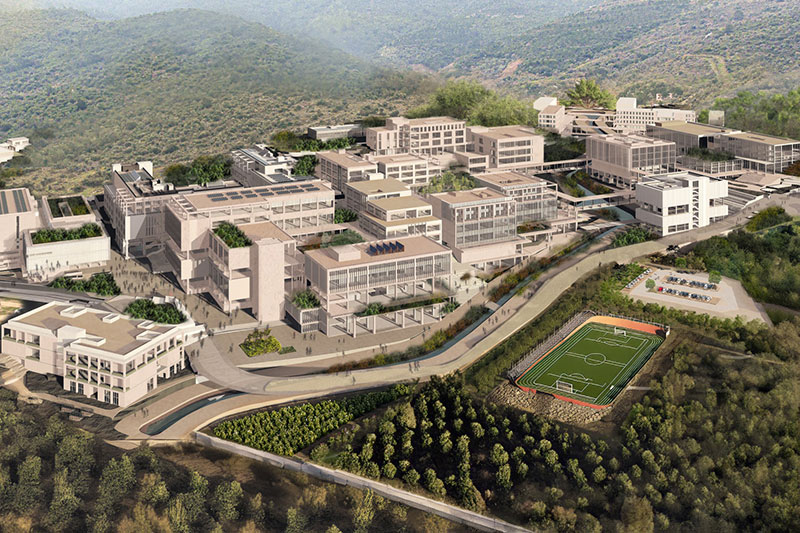
IZMIR UNIVERSITY OF ECONOMICS GÜZELBAHÇE CAMPUS
DetailsGLOBAL CAREER
As Izmir University of Economics transforms into a world-class university, it also raises successful young people with global competence.
More..CONTRIBUTION TO SCIENCE
Izmir University of Economics produces qualified knowledge and competent technologies.
More..VALUING PEOPLE
Izmir University of Economics sees producing social benefit as its reason for existence.
More..
You are one step ahead with your graduate education at Izmir University of Economics.